

Welcome to Part 31, the prevailing wage newsletter that helps federal SCA contractors protect their margins and stay compliant on post-award operations.
This week: DOL just proposed a national joint employer rule that could make your prime contract the target of your sub’s wage violation. A new FAR clause creates FCA exposure on DEI certifications and it’s already in new solicitations. The Federal Circuit made it materially easier to enforce a CICA stay on recompetes. And WHD’s FY2025 SCA enforcement data is now confirmed: $26.75M recovered, up 90% year-over-year.
In this issue:
⚖️ Lead: DOL Joint Employer NPRM — prime contract liability for sub violations
🏛️ FAR 52.222-90: new DEI clause is live and creates FCA exposure
⚖️ Federal Circuit lowers the bar on CICA stay enforcement for incumbents
📊 WHD FY2025 SCA enforcement: $26.75M confirmed — 90% spike
📖 Know the reg: Joint employer under 29 CFR Part 791
📅 Dates to remember
LEAD STORY
DOL Just Proposed a Rule That Could Make Your Prime Contract Liable for Your Sub’s Wage Violations
On April 22, WHD published a proposed rule establishing a single national standard for determining joint employer status under the FLSA, the FMLA, and the MSPA. (DOL Press Release) The practical target: clarifying when a prime contractor on a federal service contract shares liability with a subcontractor for wage violations the sub commits.
Why it matters
Joint employer status under SCA isn’t new. But a codified national standard (replacing the current patchwork of circuit-by-circuit interpretations) changes how consistently WHD can pursue primes for sub violations. Right now, enforcement exposure depends heavily on where the contract is performed. A uniform federal rule removes that geography defense.
The rule pairs with DOL’s pending independent contractor NPRM (comment period closed April 28) to form the second major WHD classification rulemaking in 60 days. Together, they’re drawing tighter lines around who counts as an employee, who counts as an employer, and who’s on the hook when wages come up short. Both rules are pre-final; monitor for publication timelines.
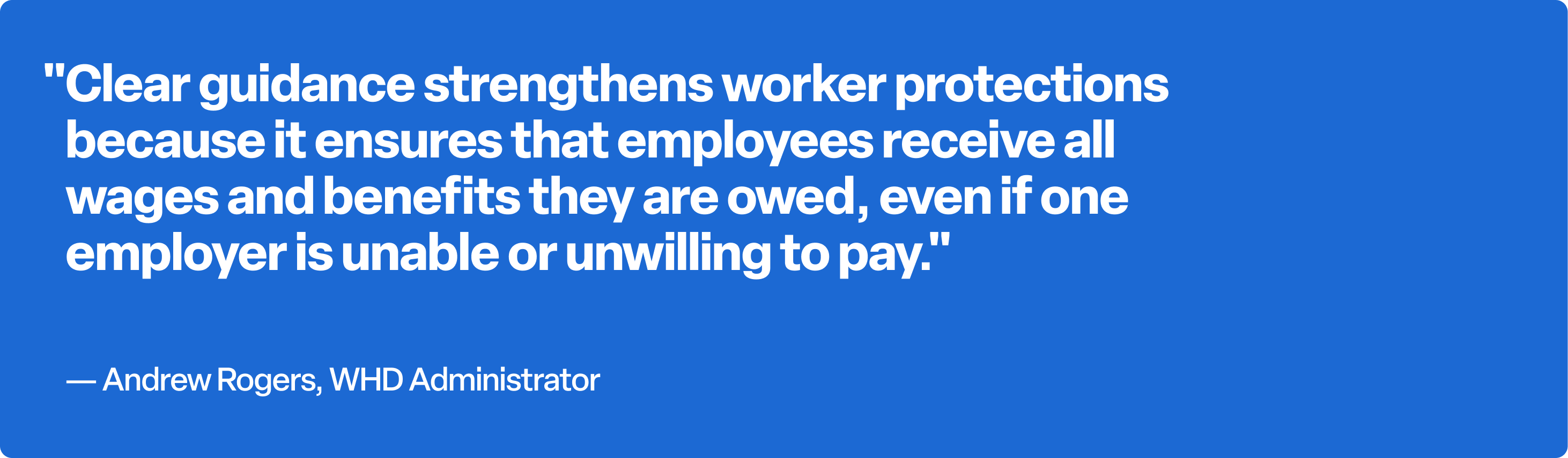
The operational implication isn’t hypothetical. WHD’s FY2025 SCA enforcement data shows $26.75M recovered across 641 compliance actions, a 90% year-over-year spike in dollars despite fewer investigations. Targeted audits. Higher recovery per action. If your sub has a wage problem and a joint employer finding sticks, that recovery comes from your contract.
What to do now
Pull your subcontract templates. Do they require subs to maintain certified payroll records and provide direct access on request? A requirement for certified payroll summaries only is insufficient if WHD decides to look upstream.
Map your subcontracting arrangements on active SCA contracts. Which subs are performing work that would be SCA-covered if done by direct hires? Those are the relationships the joint employer rule is designed to reach.
Verify your flowdown provisions include the SCA labor standards clause (FAR 52.222-41) and any applicable wage determinations, not just references to them.
If you’re pricing a recompete that relies heavily on subcontracted labor, model joint employer exposure into your compliance overhead assumptions now.

In Brief
1. FAR/DFARS · FCA EXPOSURE
FAR 52.222-90 Is Live. New Solicitations Must Include It. Existing Contracts Have Until July 24.
Effective April 24, 2026, the FAR Council directed agencies to incorporate a new clause — FAR 52.222-90 — into all new solicitations and resulting contracts. The clause implements EO 14398 (Addressing DEI Discrimination by Federal Contractors, signed March 26). Existing contracts must be modified to include it by July 24, 2026.
The clause does three things:
Requires a contractor certification of no racially discriminatory DEI activity
Makes that certification “material to payment” under the False Claims Act
Enables debarment for noncompliance
The FCA angle is the one to flag. SCA contractors are already familiar with false certification exposure from certified payroll. This clause adds a separate certification track on the same contract. If your DEI practices are in any gray area under EO 14173 and 14398, this clause converts that gray area into a payment-integrity question. Add FAR 52.222-90 to your solicitation review checklist now. Review existing contracts for the July 24 modification deadline.
Sources: FAR Council Guidance, Apr. 17, 2026 | GRSM April 2026 Update
2. CASE LAW · PROTEST STRATEGY
The Federal Circuit Just Made It Easier to Hold Your Position on a Recompete. Here’s How.
In Life Science Logistics v. United States (Apr. 15, 2026), the Federal Circuit held that a contractor challenging an agency’s CICA stay override only needs to show the agency’s decision was arbitrary and capricious, not satisfying the four-factor injunctive relief test the Court of Federal Claims had previously required.
For SCA incumbents on recompetes, this is a direct upgrade to your protest toolkit. The CICA automatic stay kicks in when a GAO protest is filed within 10 days of contract award. Agencies can override that stay, but incumbents now face a substantially lower bar to challenge that override in court. The prior standard was a significant barrier to preserving an incumbent position during a protest. That barrier is lower now.
This doesn’t change GAO protest rules or timelines. What it changes is what happens if the agency tries to move past the stay while the protest is pending. If you have recompetes in protest or nearing that window, discuss the Life Science Logistics decision with counsel before the agency acts.
Sources: Government Contracts Legal Forum, Apr. 2026 | PilieroMazza Analysis
3. WAGE DETERMINATIONS · SYSTEMS
Two SAM.gov Outages Are Still Open. No Restoration Timeline for Either.
The SAM.gov e98 form for requesting SCA wage determinations has been offline since January 30, 2026. The Feb. 19 notice about CBA rate update delays on Davis-Bacon wage determinations is still active. Neither outage has a published restoration timeline as of April 27. (SAM.gov Wage Determinations)
For e98 requests: email the completed form to scasfe98@dol.gov. Don’t wait for the portal to come back.
For CBA-linked Davis-Bacon WDs: verify current rates manually before exercising options or bidding recompetes. The WD number may be live on SAM.gov but the rates on it may be stale.
Neither outage gets discussed much, but if you submitted an e98 in the last 90 days through the portal and never got a response, you may not have confirmation that the request was received. Follow up.
Source: SAM.gov Wage Determinations
Know the Reg
29 CFR Part 791
Joint Employer
Under 29 CFR Part 791, two or more employers are “joint employers” when each has, separately or together, the right to control an employee’s terms and conditions of employment. The consequence: both employers are jointly and severally liable for wage violations, meaning WHD can pursue either one, or both, for the full amount of back wages owed.
In a federal service contracting context, this matters when a prime contractor exercises enough operational control over a subcontractor’s workforce to create a joint employer relationship. Factors WHD examines include who sets work schedules, who supervises day-to-day work, who has the power to hire and fire, and who controls the physical worksite.
Joint employer status is not triggered by every prime-sub arrangement. But SCA contracts where the prime provides direct supervision, sets shift schedules, or controls access to the worksite are higher risk than pure pass-through subcontracting. The new WHD joint employer NPRM (April 22) aims to establish a single national standard for this analysis, replacing a circuit-by-circuit patchwork that currently produces inconsistent outcomes depending on where the contract is performed.
Operational implication: if WHD finds joint employer status, your contract is the recovery vehicle, even if your sub is the one that underpaid. That’s not a hypothetical. It’s the mechanism behind prime contractor debarment exposure in cases where the sub is the direct employer.
Sources: 29 CFR Part 791 | DOL NPRM, Apr. 22, 2026
Dates to remember
May 6–7 — DOL Forum: Protecting America’s Workforce. WHD-led forum with self-audit panels. Dallas, TX.
May 11 — EO 13658 minimum wage effective date. $13.65/hr applies to legacy contracts (awarded Jan. 1, 2015–Jan. 29, 2022, not renewed after Jan. 30, 2022). Payroll system deadline, not a grace period.
May 12 — SCA Unlocked. Practical solutions for fringe, finance, and legal experts. Free. Vienna, VA. Presented by the MarshMcLennan Agency.
May 20–21 — DOL Virtual Prevailing Wage Seminar — SCA & DBA. Free. Two-day virtual seminar covering SCA, DBA, EO wage requirements, conformances, and enforcement. Registration via Eventbrite. Worth sending compliance staff.
May 26 — H-1B/PERM Prevailing Wage NPRM Comments Due. Proposed rule would significantly raise prevailing wage floors for H-1B workers. If you use H-1B labor on SCA-covered IT or professional services contracts, model cost impact before this closes.
Jul 24 — Deadline to modify existing contracts to include FAR 52.222-90 (DEI anti-discrimination clause). Mark the calendar now. Don’t let this come up at option exercise.
Forward this article. It’s a fringe benefit.
We’re building the most useful SCA resource in the market. Help us reach the people who actually need it and you will be rewarded.
Thank you to our sponsor, SCA Unlocked. Register for their networking event in Vienna, VA on May 12th to engage with experts who will guide you through the complexities of fringe benefits, financial strategies, and legal obligations to optimize your organization's compliance and enhance employee satisfaction. Understand how to navigate risks and stay current with regulatory updates. Details here.