

Welcome to Part 31, the prevailing wage newsletter that helps federal SCA contractors protect their margins and stay compliant on post-award operations.
This week: WHD recovered 90% more in SCA back wages last year, on fewer cases. That’s not a typo. The ARB also reminded everyone that writing a check doesn’t keep you off the debarment list. And a hard DEI clause deadline lands in 11 days. Let’s get into it.
In this issue:
⚖️ WHD back-wage numbers hit 90% year-over-year spike
🚨 ARB affirms debarment without willful intent
💊 ACA premiums are up 18–26%, does your fringe still work?
📖 Know the reg: FAR 52.222-43
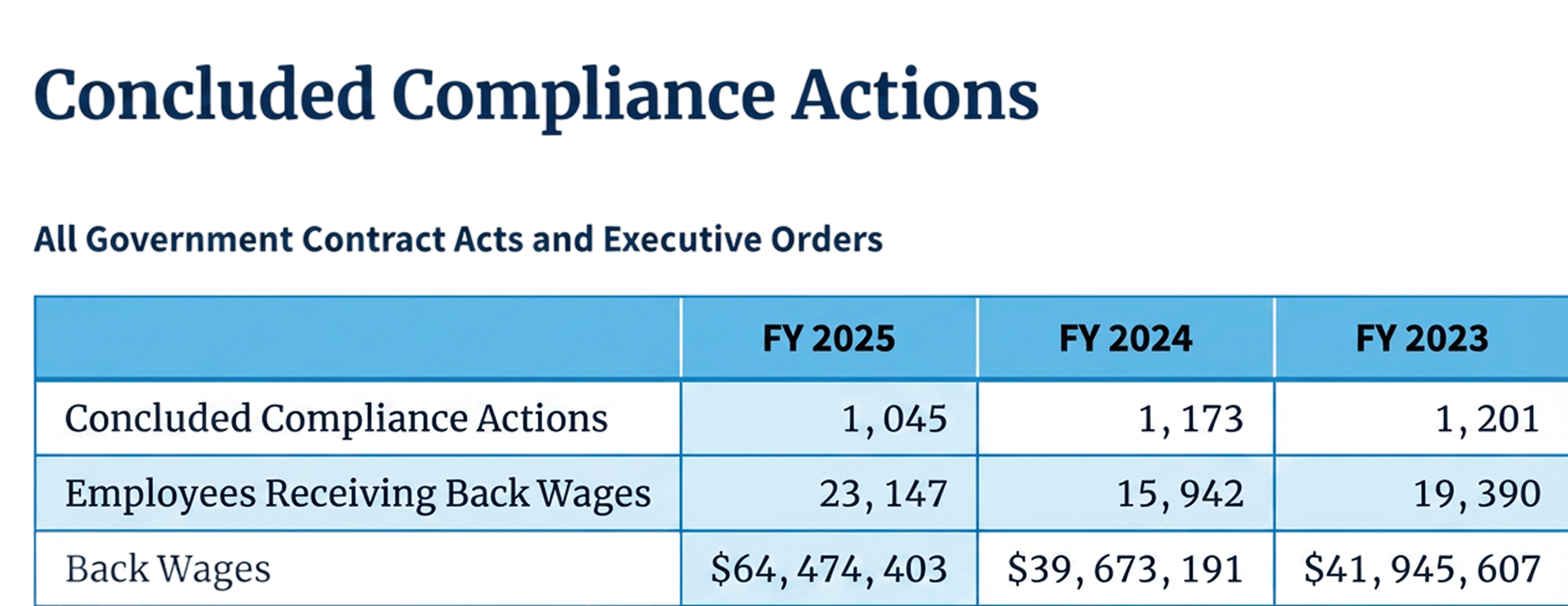
WHD recovered 90% more in back wages last year, with fewer cases
FY2025 SCA enforcement data is final. The number: $26.75M in back wages recovered from SCA contractors, up from $14.1M in FY2024. But here’s the part that should get your attention: WHD opened fewer cases (641 vs. 765) and found violations in fewer of them (445 vs. 548). The per-case recovery nearly doubled.
Fewer audits. Bigger hits. That’s not an agency losing interest. That’s an agency getting selective.
Why it matters
WHD is running a quality-over-quantity enforcement strategy. Fewer cases, higher dollar recoveries. If you think declining case volume means less risk, the data says you’re wrong.
WHD Administrator Andrew Rogers confirmed at the Capital Summit that the agency is running two tracks: fast resolution on routine complaints, targeted pursuit of “egregious” violations. If you have gaps, you’re now easier to find, not harder.
Total WHD back-wage recovery across all laws hit $259M in FY2025, the highest since FY2019. The enforcement appetite is structural. (DOL WHD Enforcement Data)
What to do now
Pull your SCA compliance posture by contract. Unimplemented WD modifications are the most common trigger for large back-wage recoveries. If there’s a contract mod you haven’t fully implemented, that’s your exposure.
Map your workforce classification. Anyone treated as an independent contractor on a covered contract is direct back-wage exposure under DOL’s pending independent contractor NPRM.
Run a fringe gap analysis across your active portfolio. If you’re within $0.50/hr of the H&W floor on any contract, close it before an audit finds it for you.
Review your certified payroll records. WHD increasingly requests these in targeted investigations. You want to know what’s in them before they do.

In Brief
ENFORCEMENT
The ARB just confirmed: paying back wages does not save you from debarment
A contractor paid every dollar of back wages and fringe benefits WHD asked for. No willful intent. Full cooperation. The ARB debarred them for three years anyway.
In Administrator, WHD v. Seven Hills, Inc. (ARB No. 2024-0005, decided January 30, 2026), the violation was straightforward: a contract modification incorporated a new wage determination, and the contractor didn’t implement it promptly. Nearly a decade of administrative proceedings later, the ARB’s holdings are worth reading slowly:
Why it matters:
Debarment does not require intentional misconduct. “Culpable neglect,” meaning you should have known, is enough.
Paying back wages resolves the monetary liability. It does not resolve the compliance failure. These are two different problems.
Debarment exposure outlasts the corrected violation. There is no statute of limitations on the underlying conduct in administrative proceedings.
Bottom line: every contract modification that incorporates a new WD is a compliance event, not administrative mail. Assign it. Track it. Implement it. (ARB Decision) | (CWC Analysis)
2. REGULATORY
DEI clause hard deadline: April 25, 11 days out
By April 25, agencies must insert the mandatory DEI compliance clause into all new and modified contracts. The EO defines “racially discriminatory DEI activities” broadly: any disparate treatment based on race or ethnicity in hiring, promotions, vendor agreements, program participation (mentoring programs, leadership tracks, ERGs), or the allocation of an entity’s resources. That last bucket is wide open, and it’s the one that will catch people off guard.
Here’s the part that changes the math: compliance is deemed “material to the Government’s payment decisions” under the False Claims Act. Every invoice you submit after April 25 is also an implicit DEI certification.
Why it matters:
The definition covers more than employment decisions. Mentorship programs with race-based eligibility, supplier diversity set-asides, and resource allocation tied to demographics all fall within scope.
This isn’t just a contract clause. It’s FCA exposure on every payment request. The treble-damage math applies.
Subcontractor flow-down obligations are included. You’re responsible for “known or reasonably knowable” noncompliance down the chain. Your subs’ DEI problem becomes your FCA problem.
FAR Council interim guidance isn’t due until May 25. The clause deadline arrives a month before the implementation guidance. Don’t wait for the guidance to start your review.
Conduct a privileged internal audit of DEI policies, training programs, and vendor agreements now. PilieroMazza’s April 22 webinar is the most targeted guidance session before the deadline. (PilieroMazza Client Alert) | (Fox Rothschild FCA Analysis)
3. FRINGE & BENEFITS
ACA premiums spiked. If you’re using marketplace plans to deliver SCA fringe, check your math.
The setup: SCA contractors owe a Health & Welfare fringe benefit on every covered contract. Many satisfy that obligation by steering employees toward ACA marketplace plans, sometimes paying part of the premium, sometimes just pointing employees to healthcare.gov and calling it done.
The problem: enhanced ACA premium tax credits expired December 31, 2025. Congress hasn’t extended them. Marketplace premiums jumped 18–26% in 2026. That means your employees’ out-of-pocket costs went up significantly, and the fringe delivery mechanism you built your bids around may no longer hold.
These are two separate compliance exposures, and rising premiums can trigger both at once:
Why it matters:
SCA fringe gap risk. Your H&W obligation is set by the wage determination on each contract. If you’re relying on marketplace plans to deliver that fringe and the employee’s actual cost now exceeds what you’re contributing, you have a gap. WHD doesn’t care how you structure it. They care whether the employee received the full H&W benefit.
ACA affordability risk. Separately, the ACA employer mandate requires that coverage cost employees no more than 9.96% of household income (2026 threshold). The safe harbor monthly cap is $129.89. If your employees’ premiums now exceed that, you may owe ACA penalty taxes on top of any SCA back-wage exposure.
ICHRA as an alternative. Individual Coverage HRAs let you set a fixed dollar contribution per employee class and let them pick their own plan. It’s the cleanest way to lock in your fringe cost and stay compliant on both the SCA and ACA side. One catch for 2026: ICHRA and Section 125 cafeteria plans cannot be combined. That integration was left out of the final budget legislation.
If you bid contracts assuming 2025 premium levels, remodel now. Don’t wait for option exercise. (AJMC) | (CBIZ)
Know the Reg
FAR 52.222-43
Fair Labor Standards Act and Service Contract Labor Standards — Price adjustment (multiple year and option contracts)
This is the clause that lets you recover SCA wage and fringe cost increases on multi-year contracts and option renewals. It’s also one of the most underused tools in a contractor’s toolkit.
FAR 52.222-43 entitles you to a price adjustment for mandatory wage determination increases, but only the portion that’s truly mandatory (new WD rates or statutory minimums), not voluntary fringe enhancements or market-driven labor cost bumps.
Two things most contractors get wrong:
The adjustment is not automatic. You have to request it and document the methodology. Nobody’s going to hand it to you.
The government has been wildly inconsistent in how it evaluates these claims, which is exactly why NOAA issued an RFI on standardizing the methodology earlier this month.
FAC 2026-01 (effective March 13, 2026) updated the clause language for the FAR Overhaul. If your contracts still reference the old version, flag it with your CO. And a tip worth its weight in billing hours: structure your original pricing to track mandatory vs. voluntary fringe components separately. It makes adjustment claims vastly easier to defend when the CO pushes back. (Acquisition.gov — FAR 52.222-43)
Dates to remember
Apr 22 — The New DEI Crackdown: What Federal Contractors Must Do Now (PilieroMazza webinar). Three days before the hard clause deadline — worth attending.
Apr 23 — Future-Proofing Your Contracts: Legal Compliance Updates (PilieroMazza, Nichole D. Atallah). FAR overhaul, SCA compliance updates, and 2026 enforcement landscape.
Apr 25 — HARD DEADLINE: DEI contract clause must be in all new and modified contracts (EO 14398). No grace period.
Apr 28 — Comment deadline: DOL Independent Contractor NPRM (economic reality test for FLSA/SCA worker classification). Submit at regulations.gov.
Apr 28–30 — ABCs of the SCA: Critical Path Training (PilieroMazza, Atallah & Nash). Three-day intensive covering WDs, fringe compliance, and WHD enforcement. Strongest SCA-specific training currently available.
May 6–7 — 2026 DOL Forum: Protecting America’s Workforce (Free, virtual). WHD, OSHA, EBSA, EEOC, IRS panels. The self-audit session led by WHD is directly relevant for SCA program development.
May 11 — EO 13658 minimum wage increases to $13.65/hr. Applies to pre-January 30, 2022 contracts not renewed under EO 14026.
May 26 — Comment deadline: DOL H-1B/PERM Prevailing Wage NPRM. Proposed Level I wage floor would shift from 17th to 34th percentile — effectively doubling entry-level H-1B wages. (DOL ETA)
Forward this article. It’s a fringe benefit.
We’re building the most useful SCA resource in the market. Help us reach the people who actually need it and you will be rewarded.
Thank you to our sponsor, CVRD Health (pronounced “Covered”). The only platform that turns complex fringe benefits into predictable, compliant, and employee-friendly outcomes. Built exclusively for government contractors, by government contractors.