

Welcome to Part 31, the prevailing wage newsletter that helps federal SCA contractors protect their margins and stay compliant on post-award operations.
This week: Your CPARS ratings just got a lot more consequential. As of April 1, past performance evaluations are no longer locked in a source selection vault. They follow you across the entire acquisition lifecycle.
In this issue:
📋 CPARS Ratings Now Visible Across the Acquisition Lifecycle
⚖ Fourth Circuit Clears DEI Certification for Enforcement
🏛️ $30M FCA Settlement Signals No Letup
🤖 DOL’s AI Initiative Targets Federal Service Workforce
📖 Know the Reg
📅 On the Horizon
Your CPARS ratings just left the source selection room.
Every agency decision maker can see them now.
The FAR overhaul went into effect April 1, 2026. The critical change: past performance evaluations are no longer marked “Source Selection Information” and no longer restricted to future source selection decisions. Starting now, your CPARS ratings, narratives, and supporting data can be used throughout the entire acquisition lifecycle.
That means contract administrators, COs exercising options, program managers reviewing task order performance, and agency officials making responsibility determinations all have access to the same performance record that used to live behind a source selection wall. Wiley’s analysis calls this one of the few “substantive changes” in the Part 42 overhaul.
For SCA contractors, this shift is operationally significant. Labor compliance performance on covered contracts, including H&W fringe delivery, wage determination conformance, and WHD audit outcomes, now feeds directly into option exercise decisions, task order awards, and responsibility reviews. A marginal CPARS rating on one contract can follow you into every other conversation an agency has about your company.
Why it matters
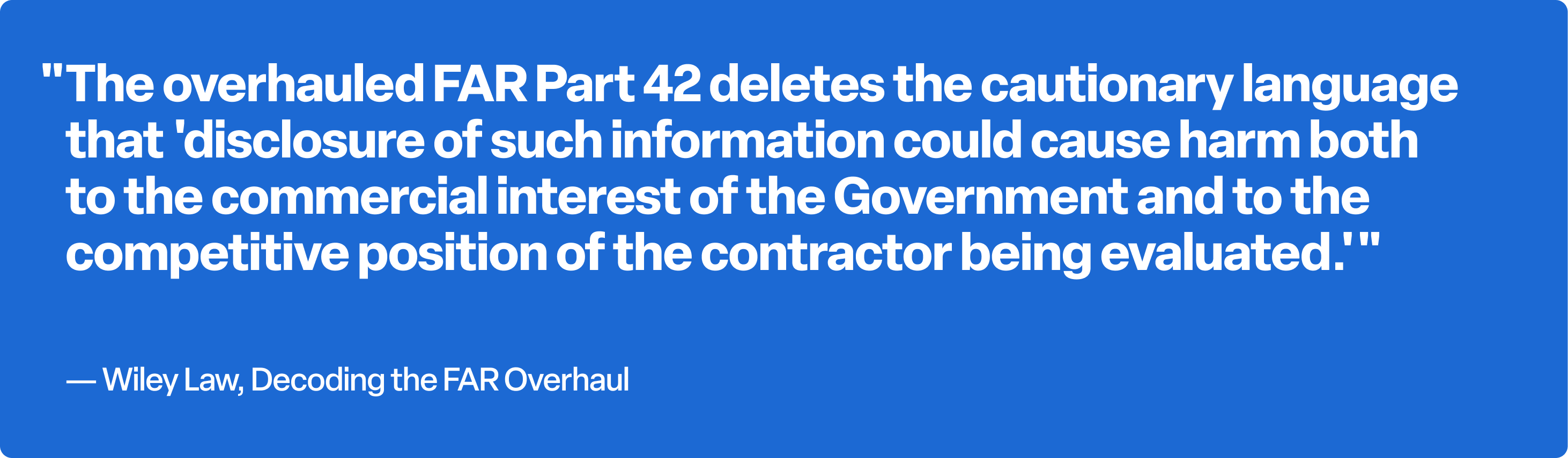
Under the old rule, a mediocre past performance evaluation hurt you in the next source selection and nowhere else. Under the new rule, it can influence whether an agency exercises your option, assigns you the next task order, or questions your responsibility on an unrelated procurement. The change also eliminates the cautionary language that previously discouraged agencies from sharing performance data outside source selection contexts.
The Acquisition Alert confirms: “Evaluations of contractor performance developed on contracts awarded prior to April 1, 2026 should be marked ‘Source Selection Information.’” Contracts awarded after April 1 carry no such marking. Your performance record is now a portfolio-wide asset or liability.
What to do now
Pull your current CPARS evaluations across all active contracts. Read the narratives, not just the ratings. If any evaluation references SCA compliance issues, wage determination errors, or WHD findings, those are now visible to every agency decision maker, not just source selection teams.
If you have pending CPARS evaluations with unresolved contractor comments, escalate them. The new visibility makes contested ratings more consequential.
Brief your program managers. CPARS is no longer an annual administrative task. It’s a continuous performance record that affects option exercises, task orders, and responsibility determinations.
Document SCA compliance performance proactively. If your H&W delivery is clean, your WD conformances are current, and your WHD record is strong, make sure your CPARS narratives reflect it.
Monitor the final rule. FAR Case 2026-012 (Parts 34, 42, and 48) is still in draft. The deviation is live now, but the permanent rule may add further changes.

In Brief
1. DEI ENFORCEMENT
Fourth Circuit Clears the Path. The DEI Certification Provision Is Now Enforceable.
The U.S. Court of Appeals for the Fourth Circuit vacated the preliminary injunction that had blocked enforcement of the EO 14173 DEI certification requirement. The court held that certifying compliance with existing anti-discrimination laws does not compel or restrict protected speech. The certification provision is now live.
But the boundaries remain unsettled. Chief Judge Diaz’s concurrence acknowledged there is “absolutely” lawful DEI activity, and the court explicitly declined to define what constitutes “illegal DEI” at this stage. Dechert’s analysis notes that “litigation challenging the Trump Administration’s anti-DEI executive actions is ongoing, and the legal landscape remains fluid.”
Combined with the March 26 EO requiring the new mandatory contract clause by April 25, this creates a two-front enforcement posture: the certification provision from EO 14173 is enforceable now, and the new FCA-backed clause arrives in 19 days. If you haven’t completed your internal DEI audit, the window is closing. PilieroMazza’s April 22 webinar is the most targeted guidance session available before the deadline.
2. FCA ENFORCEMENT
$30M Settlement Reminds Everyone: FCA Enforcement Doesn’t Take Breaks.
Two Ohio asphalt companies paid $30 million combined to settle False Claims Act allegations of submitting fraudulent testing data on federally funded highway projects. The companies allegedly submitted false lab results certifying that materials met federal specifications when they did not.
This isn’t an SCA case. But the enforcement mechanism is identical to the one now attached to the DEI contract clause. FCA materiality means the government doesn’t need to prove you intended to defraud. It needs to prove you certified something material that wasn’t true. DOJ recovered a record $6.8 billion in FCA settlements in FY2025 with 1,297 qui tam filings. The enforcement appetite is structural, not cyclical. Every compliance shortcut on a federal obligation, whether it’s testing data, DEI certifications, or SCA fringe delivery, carries the same treble-damage math.
3. WORKFORCE
DOL Launches “Make America AI-Ready.” If You Manage a Federal Service Workforce, Take Note.
DOL announced a free AI literacy course for workers on March 24, aligned with its broader AI Literacy Framework. The initiative targets workers whose jobs may be affected by AI-driven changes, including federal service contract employees.
For SCA contractors, this signals DOL’s growing attention to how AI reshapes the work performed under service contracts. If AI tools automate tasks currently classified under SCA wage determinations, questions about worker classification, covered positions, and WD applicability follow. The initiative is voluntary today. The regulatory attention behind it is not. Track this alongside the independent contractor proposed rule (comments close April 28), which could further complicate worker classification on AI-augmented service contracts.
Know the Reg
FAR 42.1503 / FAR 2.101
Source Selection Information
Until April 1, 2026, contractor past performance evaluations were classified as “Source Selection Information” under FAR 2.101 — meaning they could only be used in future source selection decisions and were restricted from broader disclosure.
The Revolutionary FAR Overhaul’s Part 42 rewrite removed that designation. CPARS evaluations on contracts awarded after April 1 are no longer marked Source Selection Information and can now be used across the entire acquisition lifecycle: option exercises, task order decisions, responsibility determinations, and contract administration actions.
The practical shift is significant. Under the old framework, a poor CPARS narrative on one contract stayed in a source selection silo. Under the new framework, it follows you into every agency decision about your company. For SCA contractors, this means labor compliance performance — H&W delivery, WD conformance, and WHD audit history — is now visible to every decision maker, not just the next evaluation board. Your CPARS record is no longer a source selection data point. It’s a portfolio-wide reputation score.
Dates to remember
Apr 15 — Labor Rules & Regulations: Federal Market Compliance (PilieroMazza). Virtual training with Sarah Nash on SCA/DBA labor compliance for federal contractors.
Apr 22 — The New DEI Crackdown: What Federal Contractors Must Do Now (PilieroMazza). Nash, Feinberg, and Brier. The most targeted DEI compliance guidance before the April 25 clause deadline.
Apr 23 — NCMA Warfighter Acquisition Forum. Ronald Reagan Building, Washington, D.C.
Apr 25 — Deadline: Agencies must insert DEI contract clause into contracts (EO 14398). Internal audit should be complete before this date.
Apr 28 — Deadline: Comments on DOL Independent Contractor Proposed Rule (DOL). The streamlined economic reality test could change SCA coverage determinations.
Apr 28–30 — ABCs of the SCA: Critical Path SCA Training (PilieroMazza). Three-day virtual training with Atallah and Nash. 2 PM–4 PM ET daily.
May 11 — EO 13658 minimum wage increase to $13.65/hr takes effect. Applies to pre-Jan 30, 2022 contracts not renewed under EO 14026. Hard effective date, not a grace period.
May 21 — DOL Prevailing Wage Seminar: SCA (Virtual). Free WHD seminar covering wage determinations, conformances, and enforcement. 11 AM–5:30 PM ET.
May 25 — Deadline: FAR Council DEI deviation guidance due. Agencies must issue interim guidance on the DEI contract clause within 60 days of the March 26 EO.
Jul 26–29 — NCMA World Congress 2026. Walt Disney World Swan & Dolphin, Orlando.
Forward this article. It’s a fringe benefit.
We’re building the most useful SCA resource in the market. Help us reach the people who actually need it and you will be rewarded.
Thank you to our sponsor, CVRD Health (pronounced “Covered”). The only platform that turns complex fringe benefits into predictable, compliant, and employee-friendly outcomes. Built exclusively for government contractors, by government contractors.